Huge defensive day helps Arizona roll over Hawaii

Huge defensive day helps Arizona roll over Hawaii

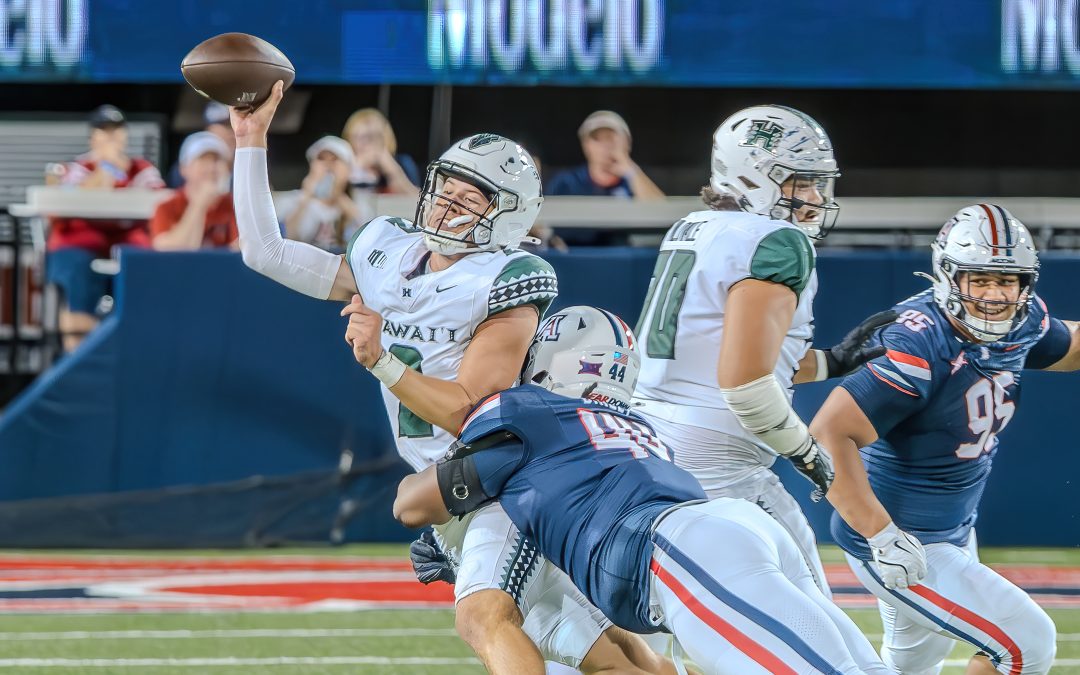
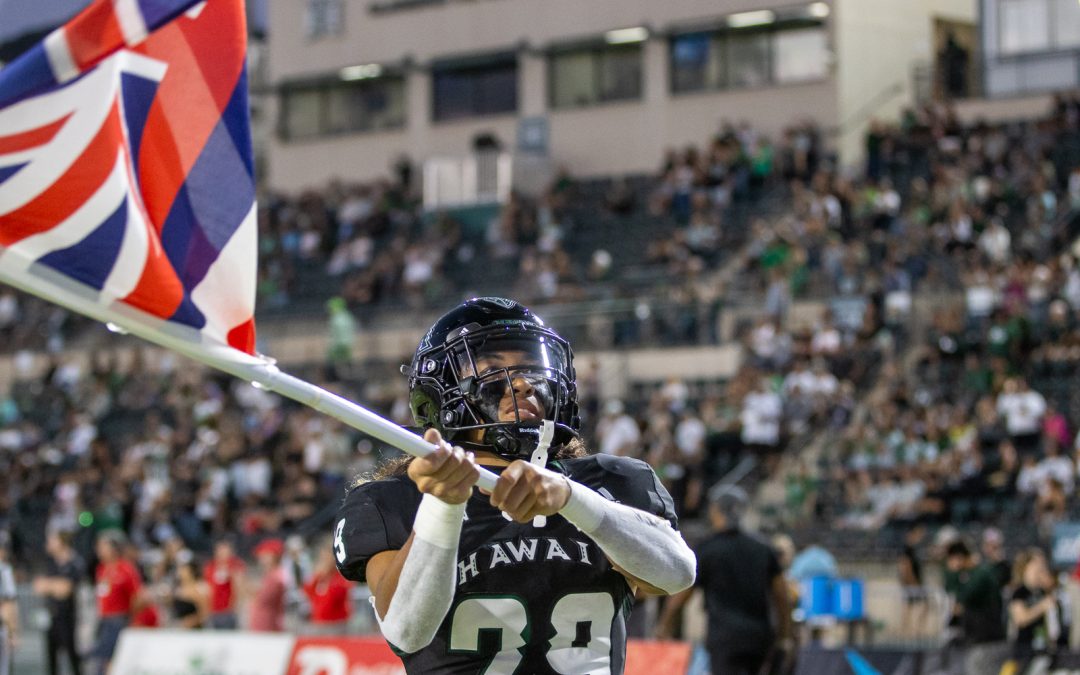
QB Luke Weaver is hit while he throws during UH’s 40-6 road loss to Arizona. | Photo Credit: Brian Bautista

Huge defensive day helps Arizona roll over Hawaii

BY PAUL BRECHT | HONOLULU
PUBLISHED AUGUST 30, 2025

Road woes continue for the Rainbow Warriors.

Behind five forced turnovers and a relentless pass rush, the University of Arizona doused the excitement coming from the islands on Saturday with a 40-6 walloping of the University of Hawaii.

Despite entering the weekend still hurting from last week’s victory over Stanford, UH QB Micah Alejado got the start for the Rainbow Warriors and completed 18-of-31 pass attempts for 157 yards and his first collegiate interception before exiting in the third quarter after he was stepped on and reaggravated his lower leg injury.

“He came in banged up, but he gutted it out, played tough,” head coach Timmy Chang said of Alejado following the game. “I think he was healthy enough to play, he wanted to give it a go. He’s going to be fine, I think. He just got stepped on.”

The fourth-year head coach turned to Modesto College transfer QB Luke Weaver for the final quarter and change of action. The junior signal caller turned in a mixed bag of results, completing 8-of-16 of his passes for 66 yards while getting intercepted twice and running for 17 yards while being credited with one fumble lost.

It was another slow start for Hawaii (1-1), who went three-and-out after receiving the opening kickoff and watched as Arizona (1-0) returned the punt 41 yards and used four total plays to march down the field for the first touchdown of the night. Wildcats RB Kedrick Reescano capped off the drive with a 13-yard scoring scamper, putting the hosts from the Big 12 up 7-0 before three minutes of clock had elapsed.

Hawaii seemed to settle in on the following drive, watching as Alejado helped point guard the offense 59 yards down the field across 15 plays before finally settling for a 34-yard field goal from K Kansei Matsuzawa.

The Rainbow Warrior defense followed up the score by forcing one of what ended up as four total punts from the Wildcats, but UH was unable to capitalize as Alejado fumbled on a sack out near midfield for his second turnover of the season. Arizona found the endzone two plays later when RB Quincy Craig, who transferred to Tucson in the offseason from Portland State, took his first Wildcat touch 54 yards for the score.

Each team added a field goal before the first half ended as UH’s defense finally held strong against Arizona in the red zone and the Rainbow Warriors converted on an end-of-half scramble scenario from 41 yards out to go into the locker room trailing, 17-6.

“I thought early on, we had a chance to move the ball on them and put ourselves in a better position,” Chang said of his team’s offense in the opening 30 minutes. “They had some explosive plays on offense and that helps them. We just got to be better.”

Things went from tough to rough in the second half as UH went three-and-out on the first two offensive chances in the second half while Arizona tacked on another TD on their opening drive of the third quarter. A screen pass to Cam Barfield bounced off the back’s hands on the next drive, going down for the first pick thrown by Alejado since his junior year of high school.

Set up inside the Hawaii 10-yard line, Arizona QB Noah Fifita took it upon himself to capitalize on the turnover by using his legs and scrambling for a 10-yard touchdown to push the Wildcats’ lead to 31-6 with just over 6 minutes remaining in the third quarter. Alejado went down on the following drive for UH after getting stepped on, ending his night and waving the white flag for the visitors.

Luke Weaver showed flashes while filling in for Alejado in garbage time, leading a pair of drives into Arizona territory before throwing a couple of interceptions of his own.  The junior took ownership for his turnovers following the game, stating the need to be better in future opportunities.

Ismali Mahdi capped the scoring for the night with a five-yard touchdown run with 4:29 left to play, putting a bow on a 40-6 blowout by Arizona.

QB Noah Fifita started his junior campaign off with a solid showing, completing 13-of-23 passes for 161 yards and a passing touchdown while also adding a score with his legs. The Wildcats tore up the Hawaii run defense, racing across the turf for nearly 200 yards on the ground and four of the five team touchdowns.

Landon Sims turned in the best day for Hawaii, rushing for 41 yards on nine carries and adding three catches for another 48 yards. Redshirt freshman WR Tama Uiliata had a nice second half as he showed a connection with Weaver, hauling in four receptions for 37 yards and drawing a defensive pass interference in the end zone.

The main concern for the Rainbow Warriors going forward will be surrounding starting QB Micah Alejado, who said he felt good after the game despite getting stepped on. Hawaii does not have the team’s first bye week until after the sixth game of the season, leaving little time for rest.

“Of course it’s frustrating, but it just comes with football,” Alejado responded when asked about having to spend another week rehabbing an injury. “I just got to do what I’ve got to do to get better.”

Alejado’s status was up in the air all the way up to Saturday’s pregame warmups, where he tested the injury and felt good enough to play. He was grateful for the opportunity to try to start, even if it may have been against better judgement.

“I was good enough to go,” the redshirt freshman responded when asked about his health ahead of kickoff. “Coach Chang allowed me to play, and you know, I appreciate him for that. At the end of the day, it probably wasn’t the best decision to play, but I was good enough to play.”

Hawaii returns home to host Sam Houston (0-2) next weekend for the first 6 p.m. HT kickoff of the season.

Three matchups to watch for in Week 1 Hawaii at Arizona

Three matchups to watch for in Week 1 Hawaii at Arizona

Hawaii DB Virdel Edwards II made his return to the field in Week 0 after missing the entire 2024 season with an injury. | Photo Credit: Michael Lasquero, HSRN

Three matchups to watch for in Week 1 Hawaii at Arizona

BY PAUL BRECHT | HONOLULU
PUBLISHED AUGUST 29, 2025

HONOLULU – Road trip, anyone?

Coming off of an exhilarating walk-off win against Stanford in Week 0, UH is looking for a second win over a Power 4 opponent in as many chances this year. The University of Hawaii (1-0) will go wheels up in Week 1, facing the University of Arizona in Tucson on Saturday for the Wildcats’ season-opener.

Redshirt freshman QB Micah Alejado showed off why fans and coaches alike were buzzing in anticipation for him to take over the top signal caller role this season in Week 0. Despite suffering a lower leg injury at the start of the second half, Alejado displayed the moxie that made him a top recruit out of the state of Nevada as he led game-tying and winning drives in the final six minutes of regulation.

The Hawaii defense, which faced plenty of questions after seeing multiple key pieces graduate and transfer away, stood strong and held Stanford to 13 offensive points and just a singular touchdown drive despite being out in the toasty midday sun for more than 36 minutes of game action.

Led by a quietly excellent day from P Billy Gowers and a heroic second-half performance from K Kansei Matsuzawa, the Hawaii special teams unit made up for an early blunder from Brandon White on the first kickoff return of the year to help play a big role in earning a season-opening victory. Redshirt freshman Tama Uiliata’s late punt return also helped set up the Rainbow Warriors’ game-winning drive.

All-in-all, a full team victory to begin the 2025 campaign for UH.

As Hawaii hits the continent for the first time this year, another group effort will need to be in store to keep an unblemished record when they return to the islands. UH opened as more than 17-point underdogs for Saturday’s matchup with Arizona, showing a need for Timmy Chang’s squad to prove itself on the road after a rough showing away from Oahu last season.

Here are three key matchups to watch out for that can help Hawaii remain within striking distance of the Wildcats on Saturday:

How does the Hawaii OL hold up against Arizona’s DL?

Starting right guard Kuao Peihopa missed UH’s Week 0 matchup against Stanford and Judah Kaio struggled early on as his replacement, getting beaten by Clay Patterson on the first offensive play from scrimmage for the Rainbow Warriors for a strip sack of Micah Alejado in the end zone. Kaio wound up being the lowest overall graded player on Hawaii’s offense in the opening week, receiving a 33.8 overall grade while struggling in pass protection and holding up a bit better in the run game.

Peihopa is expected to return in Week 1’s contest against Arizona, giving UH back a strong pass protector on the line for a tenuous QB situation. Alejado seems to be trying to give it a go despite suffering an ankle injury against Stanford while backup QB Luke Weaver has prepared for action all week in the scenario that Alejado does not play.

Regardless of UH’s quarterback, trench play will be key for the visiting Rainbow Warriors if they want any chance at an upset. Arizona features an experienced defensive line with upperclassmen starting in three of the four spots and all four spots featuring players at 6-foot-3 or larger who bring the beef at 262, 301, 301 and 252 pounds apiece for the Wildcats’ front.

The Rainbow Warriors went 1-5 last season in games where opposing defenses racked up at least four sacks and 4-2 when keeping Brayden Schager (or Alejado) from being sacked three or less times. Hawaii allowed four sacks in Week 0 as they pieced together the line through injuries to Peihopa and LT Dean Briski, winning in spite of some key pressures from the Cardinal. To beat Arizona in Week 1, UH needs to hold up in protection.

Can Hawaii’s DB hold down an experienced Arizona WR group & offense?

Led by Kilinahe Mendiola-Jensen, Virdel Edwards II and Jaheim Wilson-Jones, the Hawaii defense made Mānoa into a no-fly zone against Ben Gulbranson and Stanford in the season-opening victory as they held the sixth-year graduate transfer to a 50% completion rate and 109 yards with no touchdowns and one interception.

Arizona presents a more challenging foe for the Rainbow Warriors at signal caller than a career backup, trotting out redshirt junior QB Noah Fifita for his third year as the starter. The former three-star recruit burst onto the scene in 2023 as a redshirt freshman, winning the Pac-12 Offensive Freshman of the Year award after posting the highest single-season completion percentage (72.4%) in program history and compiling 2,869 yards and 25 touchdowns through the air.

While 2024 was a slight step back for the 5-foot-10 gunslinger and he lost top target Tetairoa McMillan to the NFL Draft, Arizona reloaded the WR room for Fifita in 2025 and hopes he looks closer to his redshirt freshman year form than last year. It’ll be on Edwards, Wilson-Jones and the entire defensive backfield to hold down a Wildcats offense that features three receivers that have combined for more than 5,000 career receiving yards and 25 total touchdown catches.

For Hawaii, limiting the Arizona air raid will be important. The Rainbow Warriors showed an ability to survive against teams that are run-heavy in Week 0, but with the help of shutting down the Cardinal through the air. If UH can follow a similar script on the road, chances of hanging tight suddenly rise.

How much can the Hawaii RB room contribute against Arizona’s front?

Since the switch to the Run-N-Shoot under Timmy Chang, the Rainbow Warriors have not consistently produced on the ground despite testing out a multitude of backs. In 2024, Hawaii ranked 124th out of 133 FBS programs in rushing yards per game and was one of 12 total programs to fail to account for more than 100 yards on the ground per game.

Week 0 actually saw Hawaii produces some ground game success, putting up more than 115 yards of production to help the offense. RB Cam Barfield made the most of six carries, running for 45 yards (7.5 ypc) while Alejado added 57 yards with his legs. With Alejado on the mend, any help that the rushing attack can muster up would help ease the load on the injured QB or Weaver in his first FBS start.

Arizona struggled mightily against the run in 2024, allowing opponents to break free for more than 170 yards on average. A more experienced front could close up some of the gaps and help the Wildcats protect on the ground this year, but Hawaii will need to test the trenches and see how much they can squeeze out of the backfield in order to pull off anything close to a road Power 4 upset.

Last-second FG helps Hawaii down Stanford for first time

Last-second FG helps Hawaii down Stanford for first time

Hawaii K Kansei Matsuzawa celebrates with teammates on the field after drilling a game-winning 38-yard field goal as time expired in regulation. | Photo Credit: Michael Lasquero, HSRN

Last-second FG helps Hawaii down Stanford for first time

BY PAUL BRECHT | HONOLULU
PUBLISHED AUGUST 23, 2025

HONOLULU – Times are changing in Mānoa.

Led by a gutsy performance from a redshirt freshman QB, a sturdy defensive effort and a pair of clutch field goals from a self-taught kicker, the University of Hawaii delivered fourth-year head coach Timmy Chang his first victory against a Power 4 program on Saturday with a heart-stopping home win over Stanford, 23-20.

Senior place kicker Kansei Matsuzawa cashed in on all three of his field goal attempts for the Rainbow Warriors, including the game-winner from 38 yards out as the clock expired. The second-year starter scored all nine points for UH after halftime and was a tidy 2-for-2 on extra point attempts.

“Unbelievable,” Chang said of his kicker. “The kid is unbelievable. Taught himself English. Went to a JUCO. First national-born Japanese player to score points in an NCAA game and we’re lucky to have him.”

Hawaii QB Micah Alejado, who remained in the game after suffering an ankle injury on a sack in the third quarter, diced up the Cardinal defense for 210 yards and two touchdowns through the air on 27-of-39 passing. The redshirt freshman also added 36 yards on the ground while getting sacked four times and fumbling once as he helped deliver the program’s first-ever win against Stanford.

“I told the team before we came out that I would die for them,” a banged-up Alejado said in the postgame. “I knew once I could walk, I was good.”

UH got off to a slow start, finding themselves in a 10-point hole less than eight minutes into the first quarter. After winning the coin toss and deferring possession to the second half, Hawaii (1-0) watched the Cardinal take up more than seven minutes on a 15-play, 70-yard opening drive that ultimately resulted in a 23-yard field goal by Emmet Kenney.

Stanford (0-1) added a touchdown six seconds later after an error on special teams from UH pinned the Rainbow Warriors at their own 1-yard line. Cardinal DL Clay Patterson beat Hawaii backup right guard Judah Kaio, who was starting in place of the injured Kuao Peihopa, on the first play, stripped Alejado and saw his teammate, LB Wilfredo Aybar, recover the fumble for a touchdown.

“I can’t take a sack in the end zone, I’ve got to know that, and I need better ball security,” stated Alejado. “The way we started off, it was bad on my part. But the defense kept rallying, offense kept rallying.”

Hawaii came back to life to close the quarter, ripping 58 yards down the field in six plays to get on the board after the defense forced a quick punt from Stanford. Alejado showed off both his arm and legs on the drive, scrambling for 34 yards and throwing for 24 more as he capped the possession with a 3-yard touchdown strike to Pofele Ashlock.

Trailing 10-7, UH got a boost from the special teams unit to start the second quarter as defensive lineman Luther McCoy blocked a 34-yard Stanford field goal attempt. It was the first blocked field goal by the Rainbow Warriors since 2022 against Utah State.

Hawaii quickly raced into Cardinal territory (with the help of a facemask penalty) to try and capitalize on the blocked kick but turned it over on downs after RB Landon Sims was stopped just short on a quick swing pass from Alejado on 4th-and-3.

Stanford chipped on a field goal on the ensuing possession, taking advantage of a ticky-tack roughing the passer penalty against Hawaii’s De’Jon Benton that extended the drive, and extended the lead to six, 13-7.

Back came the Rainbow Warriors, led by another Alejado scramble with an unnecessary roughness penalty tacked on top to jumpstart the drive.

The Cardinal continued racking up errors defensively before the break, getting flagged for a facemask penalty and unsportsmanlike conduct on back-to-back plays to help set up UH on the Stanford 21-yard line with 1:25 left in the first half. Two plays later, Alejado hit former Cardinal WR Jackson Harris for the go-ahead touchdown just before halftime.

“He came over here with a mindset to just work,” Chang said of Harris, who transferred to Hawaii in the offseason after spending two years at Stanford. “He’s a really good receiver and we look forward to just throwing him the ball more.”

Former Stanford receiver Jackson Harris is greeted by teammates after catching the go-ahead touchdown to give Hawai’i a 14-13 lead at the break. | Photo credit: Rayden Aoki, HSRN

Hawaii’s worst fears flashed in front of their eyes after receiving the second half kickoff as Alejado’s leg got twisted up on a sack by Stanford’s Matt Rose, leaving the redshirt freshman on the ground in pain as the Clarence T.C. Ching Athletics Complex fell silent. After a punt from UH and a defensive stop, the southpaw was ready to return to action despite limping off less than 10 minutes of real time prior.

“There wasn’t really a need to talk my way back in,” Alejado said when asked about playing through the injury. “That’s just not something that’s going to take me out of the game.”

The young signal caller immediately helped orchestrate an 11-play scoring drive after returning to the field, getting within kicking range and allowing Matsuzawa to connect on a 40-yard field goal to extend the Hawaii lead to 17-13 with 6:25 left to play in the third quarter.

After trading three-and-outs, Stanford committed to the ground game to re-take the lead. Leaning on sophomore RB Micah Ford, the Cardinal strung together a 20-play, 85-yard touchdown drive that bled out the end of the third frame and the first five minutes of the fourth quarter before giving a 20-17 lead to the visitors.

With Stanford driving and his squad in need a spark after the offense went three-and-out, Hawaii safety Kilinahe Mendiola-Jensen made an acrobatic play on a Ben Gulbranson pass for a game-changing pick with 5:58 left to play.

“What a great play,” Chang said of the interception by Mendiola-Jensen. “For him to come down with it [after reacting that quickly], unbelievable. Game ball deserved for him.”

Reinvigorated after the turnover, the Hawaii offense again worked to get inside the Stanford 20-yard line before Matsuzawa tied the game at 20 with 2:01 left in regulation. With trust they would get the ball back, the offense turned to the defense one last time.

Hawaii LS Jack Mowrey (left), K Kansei Matsuzawa (middle) and holder Caleb Freeman (right) celebrate after converting on the game-tying field goal. | Photo Credit: Michael Lasquero, HSRN

The Rainbow Warrior defense locked down the field, forcing a three-and-out as Jaheim Wilson-Jones came crashing in to break up a third down throw intended for WR Jordan Onovughe to get the ball back to the offense with 1:33 remaining.

“We hit adversity, we knew we were going to come and hit adversity and as a team, we were just ready for it,” Alejado said of the late-game heroics. “We knew what we were going to do when it hit and you know, all three phases were great.”

On one leg, Alejado tossed darts to Harris and RB Landon Sims to move the Rainbow Warriors to the doorstep of field goal range. A checkdown to Sims saw the senior back rumble for a 24-yard gain, setting up a 38-yard kick for Hawaii and a chance for the program’s first win over a P4 program since 2019.

Matsuzawa, who taught himself how to kick from YouTube videos and won the UH starting kicking job last season, calmly set on the right hash mark as Stanford called one of its three remaining timeouts just before the snap to try and throw off the senior’s rhythm.

Unfortunately for the Cardinal, Matsuzawa had been mentally preparing for the game-winning kick since the start of the final frame.

“I enjoy the moment,” the senior from Japan said after the game. “When we gave up the second touchdown to Stanford, I was like ‘oh this is going to be my game.’ So, I just prepared [for] game-tying field goal and also game-winning field goal. I knew that was going to happen.”

Matsuzawa calmly cashed in from 38 yards out, earning a roar from the Ching Complex crowd as Hawaii took a 23-20 lead as time expired.

Ashlock led the Rainbow Warriors’ receiving attack, hauling in nine catches for 69 yards and a touchdown to begin his junior campaign. In his UH debut, Jackson Harris racked up six receptions for 59 yards and a score against his former squad.

Cam Barfield led the ground game for Hawaii, totaling 45 yards on six carries while adding one catch for 10 yards in his first start of the season. Landon Sims had seven rushes for 12 yards, but added 32 yards in the receiving game as he caught four passes out of the backfield.

Peter Manuma and Jamih Otis each had eight tackles (6 solo) to lead the way for UH while Manuma added his first QB sack since his freshman season. Kilinahe Mendiola-Jensen flew around the field for the Rainbow Warrior defense, doing a little bit of everything as the senior racked up four tackles, a team-leading two PBUs and his first career interception.

Stanford QB Ben Gulbranson finished the day 15-of-30 passing for 109 yards and an interception. Sophomore running back Micah Ford turned in a strong effort despite the loss, totaling 113 yards and a touchdown across 26 carries.

Hawaii returns to action next Saturday, hitting the road to face another former Pac-12 foe in the University of Arizona. The Wildcats were idle in Week 0 and will kick off their 2025 season against the Rainbow Warriors at 4:30 p.m. HT on TNT.

Three matchups to watch for in Week 0 Stanford-Hawaii

Three matchups to watch for in Week 0 Stanford-Hawaii

Hawaii QB Micah Alejado prepares to take a snap in his first home start as a college player. The redshirt freshman was handed the keys to the UH offense this offseason. | Photo Credit: Michael Lasquero, HSRN

Three matchups to watch for in Week 0 Stanford-Hawaii

BY PAUL BRECHT | HONOLULU
PUBLISHED AUGUST 22, 2025

HONOLULU – The dog days of summer are (just about) over.

Prepare to hear the crunch of shoulder pads colliding on college fields across the country every weekend until the middle of January.

The 2025 college football season is right around the corner.

The University of Hawaii and Stanford will close out the five-game slate of Week 0 action on Saturday, matching up for the fifth time ever and the first time since 2023. That clash between the Rainbow Warriors and Cardinal went in favor of the visitors from California, 37-24.

Things have changed a decent bit for each program since that meeting two years ago.

Stanford moved into the ACC and is now led by new general manager Andrew Luck and interim head coach Frank Reich after the somewhat-unceremonious exit of Troy Taylor. The Cardinal lost starting quarterback Ashton Daniels to Auburn and star pass rusher David Bailey to Texas Tech via the transfer portal while they brought in a program-record 17 new faces from the portal themselves.

Despite the fresh roster, Stanford enters 2025 with the lowest projected win total among Power 4 programs.

Hawaii faces the highest expectations of fourth-year head coach Timmy Chang’s tenure as they enter the Micah Alejado era at quarterback. Flanked by a pair of preseason all-conference receivers in Pofele Ashlock and Nick Cenacle, the redshirt freshman QB has many fans thinking bowl for the ‘Bows after his scintillating starting debut last season.

Both sides have eyes on starting the 2025 campaign on a high note. Here are three key matchups to keep a look out for on Saturday that can swing the needle.

Hawaii WR corps vs. Stanford secondary unit

Studs on studs.

The Rainbow Warriors have talent oozing from everywhere in the wide receiver room. While they’re led by Ashlock and Cenacle, many around the UH program are excited to see what Kentucky transfer Brandon White and former Cardinal WR Jackson Harris can bring to the unit in 2025.

Add in senior Karsyn Pupunu, Arizona State transfer Max Ware and a multitude of others and the list of productive pass catchers just goes on for Hawaii. Did we mention that they’re listing tight ends on the two-deep this season after not doing so at all in 2024?

Even better for UH – Alejado is more than happy to use all those options while picking apart a defense.

Stanford’s defense struggled last season against top opponents but had significant ball production on the back end with nine interceptions. Senior CB Collin Wright should serve as the unit’s top dog in 2025 after leading the squad a year ago with three picks and is projected to start on Saturday for the Cardinal.

Dartmouth graduate transfer CB Jordan Washington, an All-Ivy League first-team selection in 2024, will likely get a chance to play a big role in his first game with Stanford as well. With multiple standouts in the safety room (Jay Green, Scotty Edwards), the experienced defensive backfield of the Cardinal will look to build off positives from last year and hold down a dynamic UH group.

Stanford TE Sam Roush vs. Hawaii Safety & Linebacker corps

One of the most critical battles for the Rainbow Warriors, veteran safeties Peter Manuma and Kilinahe Mendiola-Jensen will serve as part of the counter for the hosts against Stanford tight end Sam Roush. The Nashville native was a four-star prospect out of high school and broke out last season with 40 catches for 334 yards after former Cardinal standout Benjamin Yurosek transferred to Georgia.

Hawaii fans may remember Yurosek’s name after he torched the Rainbow Warriors to the tune of 138 yards and a touchdown across nine catches when the teams last met in 2023. While Yurosek can’t break the hearts of UH fans anymore, Roush has the capability of carrying the torch as a big-bodied pass catcher and experienced security blanket for QBs.

The senior tight end also is the top returning target for the Cardinal after they lost WR Elic Ayomanor (63 rec, 831 yards, 6 TDs) to the 2025 NFL Draft, redshirt freshman WR Ismael Cisse (26 rec, 241 yards, 2 TDs) to Arkansas and freshman WR Emmett Mosley V (45 rec, 525 yards, 6 TDs) to Texas via the transfer portal.

If Manuma and Mendiola-Jensen (along with others within the UH defensive spine) can help neutralize Roush’s impact on Saturday, the Cardinal passing attack will be forced to lean on lesser-known commodities like transfers CJ Williams (Wisconsin) and Caden High (South Carolina State).

Stanford prized freshman WR JonAnthony Hall has been listed as questionable entering the weekend after missing several practices throughout camp with an injury and would be an X-factor with a surprise suit-up against the Rainbow Warriors. Hall’s likely absence should only increase Roush’s importance in new starting QB Ben Gulbranson’s first start.

Hawaii’s 3rd Down Offense vs. Stanford’s Defense

One of the most underrated skills for a defense is getting off the field on third down. Just ask the Cardinal.

Stanford’s three victories during the bumpy 2024 campaign came in the only contests where the defense held opponents to a third-down conversion rate of 40% or less. In six road games last year, the Cardinal allowed four teams to convert on 50% or more of their third down opportunities.

Hawaii converted on an astounding 62.5% of third down chances against New Mexico to end last season, the only start for Alejado at the college level so far. The Lobo defense was among the worst in all of FBS football, so even a Cardinal squad that struggled against Power 4 squads last year is a step up in competition for the redshirt freshman signal caller.

Should the left-handed gunslinger want to pass the next test in his young college career and deliver a win on national television against a Power 4 squad for fourth-year head coach Timmy Chang, converting on the money down on Saturday will be critical. The Rainbow Warriors, not known for a powerful rushing attack, must work themselves in “third-and-manageable” situations and convert often if they want to start the 2025 season off on the right note.

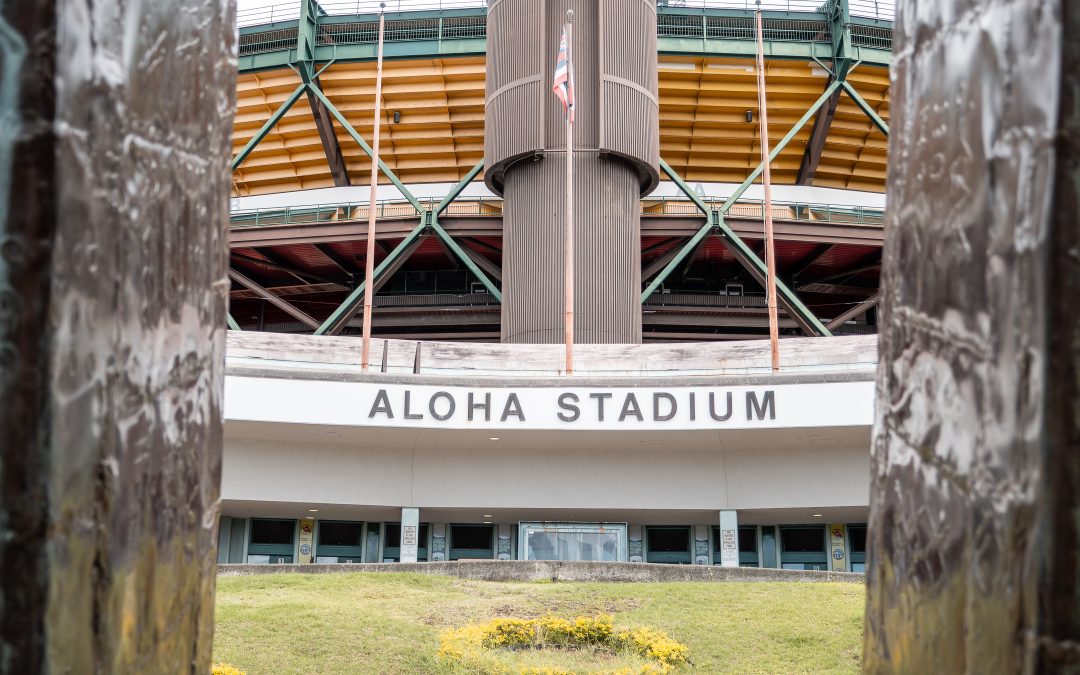
Stadium authority agree on terms for new stadium: the good news and ‘not so good news’

Stadium authority agree on terms for new stadium: the good news and ‘not so good news’

Stadium authority agree on terms for new stadium: the good news and ‘not so good news’

BY MICHAEL LASQUERO | HSRN
PUBLISHED AUGUST 14, 2025

‘AIEA — After talks of a new aloha stadium in Hawai’i being on the proverbial 10-yard line and at first-and-goal, points are now on the scoreboard.

Now were those points a touchdown or a field goal? That depends on perspective.

Wednesday morning marked a momentous step forward for construction for the New Aloha Stadium Entertainment District (NASED) as the Stadium Authority board voted unanimously in a special session to finalize terms of a new stadium agreement with master developer Aloha Halawa District Partners (AHDP).

Demolition of the existing structure that was condemned is still on track to take place by the end of August with the final permits expected to be approved next week.

But officials say the stadium’s timeline has been pushed back from August 2028 to March 2029 and that the seating capacity in the current plans have been reduced from 25,000 to 22,500.

Former Stadium Authority Board chair Brennon Morioka — and current senior advisor to Gov. Josh Green for the NASED project — has always maintained that there will be transparency in the project’s developmental progress.

When he addressed the media after the board’s special session, Morioka said that entails “the good news as well as some of the not so good news.”

Brennon Morioka addresses the media following the stadium authority board special session.

THE GOOD NEWS

The conclusion of Wednesday’s special session resulted in a milestone achievement that was put into motion over two decades ago. It should be celebrated.

Current board chair Eric Fujimoto said the conversation of building a new aloha stadium started in 2002 when Charlie Taguchi was leading the board. Then during Ross Yamasaki’s leadership, the board was able to get deed restrictions and approach the state legislature for funding for a new structure which then was secured during Morioka’s time as chair.

The unanimous vote by the board on Wednesday authorizes interim stadium manager Chris Sadayasu permission to finalize the ground lease agreement and operations agreement with AHDP, stadium leadership and the state’s Department of Accounting and General Services.

The state of Hawai’i has never reached this point in its many attempts to rebuild aloha stadium, even before it was condemned at the end of 2020. There were plans to build a new stadium while the old one was still operational during David Ige’s time as governor while current Gov. Josh Green switched gears on the project during the 2023 legislative session before restarting the project in December 2023.

Demolition of the existing structure will begin in the coming weeks. There will be physical signs of the old stadium being taken down to make way for the new.

The final permits needed for a piece-by-piece demolition is expected to take be approved next week, stadium officials said.

It was a permitting process put into motion by AHDP a few months ago — before any agreement by parties involved had been reached. This was done ahead of time so that demolition could start almost immediately when contracts are actually signed.

“As a local guy that lives in the Pearl City-Aiea area, to see demolition occur is just going to be a huge psychologically for our community,” Fujimoto said.

Stadium Authority Chair Eric Fujimoto addresses the media.

While the state and AHDP still need to agree on two aspects of the full contract — a mater development agreement and a shared infrastructure agreement — the board’s vote to approve of the ground lease agreement ensures that demolition can begin.

The terms of the stadium contract that is being agreed upon do not have any future burden on taxpayers — unlike other state projects.

During Ige’s time as governor of Hawai’i, he signed Act 248 into law, which allocated approximately $400 million towards the NASED project — specifically $350 million in general obligation bond funds for the Capital Improvement Project related to the new stadium.

Those monies will not completely cover the price tag of a new stadium, so the expectation is that AHDP has to fund the difference needed.

“It’s important for the public to understand and make sure that they know the state right now is only committed to $350 million dollars,” Morioka said.

“Not only is the state making a significant investment, but AHDP is making a significant investment in this stadium as well.”

The new stadium will be constructed in a way that can be expanded upon without halting operations. If there is a need and resources to increase capacity, there is the option to.

While the state is currently not committing more than the $350 million towards the current stadium plans, there is a possibility that additional external monies come in that can help support a bigger, better stadium, Morioka said.

If those additional funds from other parties become a reality, Morioka said expanding on the stadium’s seating capacity can take place. Morioka, who is the Dean of College for Engineering at the University of Hawai’i, said the current stadium plans will use an additive type of construction.

“Everything that might come in the future, even if it’s near term or long term, it’s additive that they can just build onto the current stadium that they’re going to be building so that there’s not as much disruption towards the use of the stadium should we start adding on, which we do have a high level of confidence that we’ll be able to do so in the future,” Morioka said.

THE NOT SO GOOD NEWS

The 22,500 seating capacity in the current plans that was agreed upon by the stadium authority board is below the minimum amount of seats that was required.

The current attempt at building a new stadium began in December 2023 when the state published a Request for Proposals (RFP) that outlined a three-stage procurement process in hopes of finding a private developer entity to serve as the master developer for NASED.

One of the key features of the RFP states that “the master developer will be responsible for designing, building, operating, and maintaining the new Aloha Stadium with a minimum of 25,000 seats.”

There were two priority-listed offers that were selected in March 2024 as finalists to bid for the NASED contract but one of the two developmental teams withdrew its name a few months later and AHDP was the only option for the state to continue negotiations with.

The timeline of construction completion of the new stadium was pushed back from August 2028 to March 2029, partially because of factors that are outside of the state’s control.

The projected completion of August 2028 for the new stadium was a timeline set in place in December 2023. Morioka hinted at the previous stadium authority board meeting that timeline could become  “end of 2028” before announcing of its current projected finish on Wednesday.

Morioka told the media after the special session that August 2028 was an “aggressive date to target” while March 2029 is a “very realistic date, very achievable date.”

He said that conversations with AHDP and their contractors — such as Hawaiian Dredging — and the current environment of tariffs and material supply chains led to the new timeline.

China is the world’s biggest producer of steel, but the United States increased the tariffs on steel from 25% to 50% in June 2025.

The final price tag of the new stadium is not set in stone. There is a limit to how much AHDP wants to spend, which could affect quality of final product.

When Morioka said that the state is only committed to $350 million dollars towards the stadium, he also said: “we’re probably looking at AHDP putting in upwards of $475 million dollars total for a new stadium.”

However, a NASED official later clarified to HSRN that the $475 million amount only relates to the total cost of the stadium, not how much AHDP is giving to the project.

AHDP is also in charge of the demolition process and costs, with plans to preserve the existing cement foundations of the end zones of the former stadium to help save nearly $90 million.

UH, Spectrum agree to drop PPV, air football games statewide

UH, Spectrum agree to drop PPV, air football games statewide

Photo Credit: Michael Lasquero, HSRN

UH, Spectrum agree to drop PPV, air football games statewide

BY PAUL BRECHT | HONOLULU
PUBLISHED AUGUST 11, 2025

HONOLULU – Breaking down old barriers.

The University of Hawai’i announced a one-year extension with Spectrum on Monday, continuing a partnership with the broadcast service as the official television home of Rainbow Warrior and Wahine athletics. Additionally, Spectrum will drop the pay-per-view fees and broadcast delays for their seven UH football games for the first time as part of the agreement.

“We’re thrilled to make Rainbow Warrior football more accessible than it has been in decades,” said UH Mānoa Athletics Director Matt Elliott in a press release. “No tape delays. No pay-per-view. No added fees for anyone already watching UH sports at home.”

Hawaii football enters the year with five nationally televised contests scheduled, leaving the remaining seven games for Spectrum to broadcast. Six of those games will come at home (UH’s August 23 opener against Stanford will be on CBS) while the October 18 matchup at Colorado State will also be broadcast on Spectrum.

Spectrum customers with Spectrum TV Select Plus or Spectrum TV Platinum will be able to watch Rainbow Warrior football on channels 12 and 1012 or via the Spectrum TV app, per the release. Hawaiian Telcom customers will also have live access without pay-per-view fees or delays while viewers outside of Hawaii can access broadcasts via the Mountain West app.

“This partnership with the University of Hawai’i expands access to more fans and brings exceptional value to our customers,” Dan Schmidt, senior director and coordinating producer for Spectrum Sports said. “We are looking forward to an unforgettable season, delivering high-quality sports coverage that will allow viewers to catch all the excitement.”

Pay-per-view access has been a sticking point for many fans in recent years with questions surrounding how the football program would create a new generation of Rainbow Warrior fans. Neighbor island fans without access to pay-per-view football packages pointed out difficulties in seeing the team play despite the actual desire to support being there.

“Hawaiʻi’s passion and loyalty for UH is something any pro team would envy,” Elliott stated. “We had an opportunity to do something different this season, and we went for it. This is our way of saying mahalo to the greatest fans in the world.”

The football program is entering its fourth season under the stewardship of head coach Timmy Chang and looks to take the next step back towards national relevance after rebuilding from the ground up. With redshirt freshman QB Micah Alejado and multiple all-conference weapons leading the charge, Hawaii hopes to return to the postseason for the first time under Chang with fans along for the entire ride.

Elliott believes that increasing access of UH football on television will not only increase ratings but can help bring an influx of fans for actual attendance numbers.

“What we believe is that if we invest in the community, invest in the people who support UH athletics, and in this case, specifically UH football, we’re going to build momentum,” the UH athletics director said during his media availability.

He pointed to the return of tailgating among a multitude of improvements to the fan experience that the school is looking to make for the upcoming season and beyond while talking about the product on the field being the main attraction for those in-person and at home.

Elliott also said that the contract with Spectrum has been a major priority to finalize since taking over. The deal extends further than football as Spectrum will broadcast around 90 live UH events.

UH President Wendy Hensel also spoke to the importance of the deal and how it was an example of how the university is committed to serving the community. Fans from all over the state will have the chance to be connected to UH and strengthen fandom for the next generation.

“We want to open the door to our fans, whatever island they are [located on], for access,” Hensel said Monday. “That’s part of the university’s strategy, that we meet the demands of every island and provide access for every career opportunity. Same with athletics. It’s no fun if we can’t give access to our fans for whom it is not easy to for them to gain entry [because they’re] on a different island.”