Aloha Stadium document reveals important NASED timeline dates

Aloha Stadium document reveals important NASED timeline dates

Aloha Stadium document reveals important NASED timeline dates

HONOLULU — Giving gifts like flowers and chocolate are quite common on Valentine’s Day.

For the state of Hawai’i this year, physical evidence towards the dismantling of the old Aloha Stadium will be on display during the festive day.

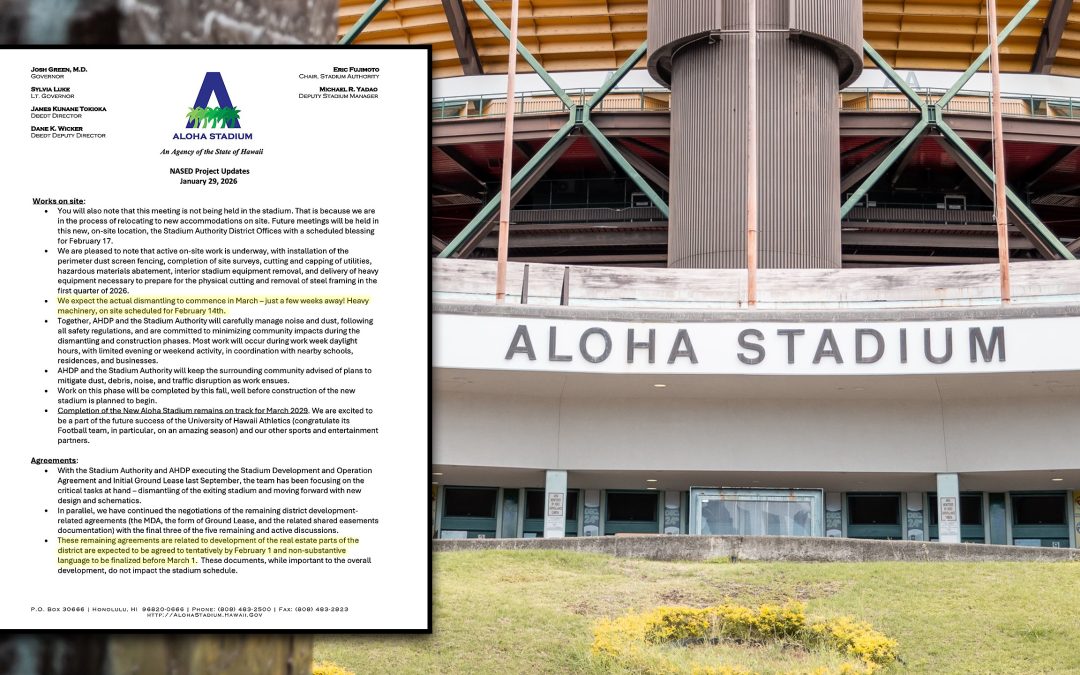
Heavy machinery to help with the demolition of the condemned structure is scheduled to be on site in Halawa on Feb. 14, per public documents on the stadium’s website.

The documents were posted seven days before the Stadium Authority Board’s scheduled monthly meeting this Thursday, which will be held at the Leiopapa a Kamehameha building, also known as The State Office Tower.

The board held its final meeting in the stadium’s old office space last month and will move into its new on-site location next month after a scheduled blessing on Feb. 17, per the document.

Other important details that the document notes is that active on-site work is underway, with installation of the perimeter dust screen fencing, completion of site surveys, cutting and capping of utilities, hazardous materials abatement and interior stadium equipment removal.

The heavy machinery and equipment that are being delivered on site next month will be used for the physical cutting and removal of steel framing in the first quarter of 2026, with actual dismantling to start in March, the document states.

All of the work in the dismantling phase is expected to be completed by the fall, well before construction of the New Aloha Stadium Entertainment District (NASED), per the document.

The Stadium Authority and Aloha Halawa District Partners (AHDP) are also expected to come to terms on major agreements in the coming weeks, the document notes.

While the Stadium Development and Operation Agreement and Initial Ground Lease were agreed to last September, negotiations related to the district development agreements are still ongoing.

The document reveals that the Master Developmental Agreement (MDA), the form of Ground Lease and the related shared easements documents are expected to be agreed to tentatively by Feb. 1 and non-substantive language to be finalized before March 1.

The current state of the demolition period and the ongoing negotiations of the remaining district-developmental agreements do not impact the current opening date of March 2029 for the new Aloha Stadium, concludes the document.

End of an Era: Demolition of Aloha Stadium has begun

End of an Era: Demolition of Aloha Stadium has begun

End of an Era: Demolition of Aloha Stadium has begun

‘AIEA — Aloha Stadium Authority Chair Eric Fujimoto made it crystal clear Thursday morning — “demolition/dismantling of Aloha Stadium has begun.”

December’s Stadium Authority board meeting marked the end of an era with the announcement that steps to remove the current structure of Aloha Stadium have already started in preparation for the construction of the New Aloha Stadium Entertainment District (NASED).

“This is a pretty historic thing,” Fujimoto said. “We’re going to say aloha to a community asset, but also build a new community asset for people to share community and culture.”

The announcement of dismantling comes about five years since the old Aloha Stadium ceased operations in December 2020 after being condemned due to years of deferred maintenance and structural safety concerns.

NASED Special Projects Manager Chris Kinimaka provided an update on the project, saying key agreements and preparations have finally aligned to allow physical work on the site to move forward.

“We have very exciting news happening just this past week,” Kinimaka said. “Since September, execution of the necessary agreements to open the floodgates for the stadium work has come to fruition.”

Among the recent milestones, the stadium swap meet was successfully relocated in October and the relocation of stadium offices is underway, with a target completion in time for the January 2026 board meeting. The December 2025 meeting marked the last time the board would meet in the stadium’s current office space.

The conference room where the Aloha Stadium Authority Board held its meetings prior to January 2026.

Kinimaka said Aloha Halawa District Partners (AHDP), the project’s developer, completed its upfront work to procure materials and equipment and to finalize subcontracting needed for the dismantling process. Active work for dismantling on the site began Friday, Dec. 12.

Motorists passing the area will begin to notice changes, including the installation of dust fencing starting from the north side of the property. Early work includes site preparation, removal of hazardous materials from inside the stadium and dismantling of interior equipment and furnishings before crews begin taking down the main structure.

While much of the work may not be immediately visible, Kinimaka said the state and developer are committed to keeping the public informed.

“We are asking the developer to take good pictures and put them on site so everybody can stay up to speed on what’s happening and stay connected to all the activity,” he said.

The state will work closely with AHDP to ensure environmental safeguards are in place, including dust control, traffic management and regular communication with the surrounding community. Most of the work is expected to take place on weekdays during normal business hours.

In September, project leaders announced that AHDP signed two key agreements: the Stadium Development and Operation Agreement, which covers dismantling, design, construction and long-term operations of the stadium, and an Initial Ground Lease granting access to portions of the site to support the work.

The master development agreement and infrastructure agreement, which relates to the district’s real estate development, have not been signed yet.

“The remaining agreements for development of the real estate parts are continuing,” Kinimaka said. “We’re anticipating that being wrapped up in the coming months.”

Despite the ongoing negotiations, officials said the project remains on schedule, with completion of the new stadium targeted for March 2029.

Stadium board member Claire Tamamoto, who is on the board as a ‘Aiea community member, raised questions about traffic impacts and debris removal.

Kinimaka said cranes are already on the island and are being relocated to the site, typically after hours. Trucks hauling debris will follow designated routes and schedules to minimize impacts on major roadways, including Kamehameha Highway.

Project leaders are also working to salvage as much material as possible from the old stadium, including steel, with specialized companies brought in for that effort. Final destinations for the debris are still awaiting approval.

University of Hawai‘i Athletic Director Matt Elliott welcomed the update, calling the start of dismantling “wonderful news” for the future of UH athletics and the state. The Rainbow Warriors have had to play home football games on campus in a retrofitted stadium since the old Aloha Stadium ceased operations five years ago.

Elliott also shared a monthly update about UH athletics to the Stadium Authority and highlighted the continued growth of attendance on campus at home football games over the past two seasons. He noted that UH sold out three of the seven Rainbow Warriors’ games and that there were around 88,000 fans in attendance throughout the 2025 season.

Hawai’i football fans take part in the 2025 season-opener against Stanford, one of three sellouts this season.

As the university prepares to become a full member of the Mountain West Conference ahead of the 2026 season, Elliott also shared attendance figures from around the league to provide context for UH’s current trajectory.

He said Fresno State led the conference in average attendance this past season, drawing about 38,000 fans per game and that the Mountain West average ranged between 26,000 and 27,000 fans per game.

UH posted the lowest average attendance in the conference at approximately 13,700, though Elliott noted the number reflected capacity limitations at on-campus venues rather than a lack of interest.

“Just to give you some context what attendance was like in the Mountain West Conference this year and thinking about what our capacity is going forward,” Elliott said. “But obviously, we’re trending in a very good direction for us and excited about our full membership in the Mountain West.”

The current plans for the new Aloha Stadium is for a seating capacity of 22,500 — although there is potential for expansion if additional external monies come in towards the project.

Among other actions at its December meeting, the Aloha Stadium Authority board appointed member Mike Yadao as deputy stadium manager.

Tamamoto praised the selection, citing Yadao’s background as the project shifts deeper into the construction phase of the New Aloha Stadium Entertainment District.

“He is a good choice as we move into a different phase of the developing of the stadium,” Tamamoto said. “You have a construction background. We’re not managing anything — it’s not an operational thing anymore. We need those bricks and cement, so I wish you luck.”

The deputy stadium manager role was previously held by Chris Sadayasu, who was promoted to interim stadium manager earlier this year following the departure of Ryan Andrews at the start of the calendar year. Sadayasu was not present at the December meeting and has since transitioned to another role within state government.

Fujimoto commended Sadayasu’s leadership during his interim tenure.

“I couldn’t be prouder of how he has done in the interim stadium manager position,” Fujimoto said. “I think he’s brought us to this point today as we transition. I wanted to wish him and his family well. He’s still with the state.”

The board also approved a measure delegating authority for the upcoming 2026 legislative session to track legislation related to the Stadium Authority and to draft and submit testimony on its behalf, consistent with board-adopted policies.

That authority was granted to Vice-Chair Andrew Perreira, Deputy Stadium Manager Yadao and member Michael Imanaka.

Fujimoto said the group will continue to meet regularly and provide updates to the board as the legislative session progresses.

Major Milestone for the New Aloha Stadium Entertainment District

Major Milestone for the New Aloha Stadium Entertainment District

Conceptual rendering courtesy of Aloha Halawa District Partners

Major Milestone for the New Aloha Stadium Entertainment District

BY HSRN STAFF
PUBLISHED SEPTEMBER 25, 2025

The New Aloha Stadium Entertainment District (NASED) has officially taken a major step forward. Project leaders announced that the first two agreements with Aloha Hālawa District Partners (AHDP) have been signed, paving the way for the dismantling of the current Aloha Stadium and the start of construction on a modern, multipurpose facility.

WHAT’S NEXT FOR THE STADIUM

  • Dismantling Timeline: Work to take down the existing stadium will begin soon, with completion scheduled for July 2026.
  • Construction Timeline: Building the new stadium is expected to take about two and a half years, with doors projected to open in March 2029.
  • Operations: AHDP will operate and maintain the stadium for 30 years before returning it to the State of Hawaiʻi.

The agreements include the Stadium Development and Operation Agreement, which covers dismantling, design, construction, and long-term operations, as well as an Initial Ground Lease granting AHDP access to parts of the site to support the project.

Features of the New Stadium

  • Seating for 22,500 fans with future expansion potential
  • 10 luxury boxes for enhanced experiences
  • A design flexible enough to host UH football, soccer, rugby, concerts, community events, and major gatherings

The state is contributing $350 million toward dismantling and construction.

Community and Leadership Reactions

“These agreements are a big step forward for Hawai‘i. Mahalo to all the dedicated individuals transforming our community’s vision into reality… We hope generations of those with Hawai‘i in their hearts will come here to dream, celebrate, and make lasting memories.”
— Eric Fujimoto, Stadium Authority Chair

“This moment reflects years of planning and dedication… There is much hard work ahead, and all of us at AHDP are approaching these next steps with the same single-minded focus and urgency required to deliver our dynamic vision for the people—and for the future—of Hawaiʻi.”
— Stanford Carr, President, Stanford Carr Development & AHDP Master Developer

“Today’s agreements are an encouraging milestone for the new Aloha Stadium and for the future of UH Athletics… We are excited to see momentum building.”
— Matt Elliott, University of Hawaiʻi Athletics Director

What’s Next for NASED

With the Stadium Development and Operation Agreement and the Initial Ground Lease in place, additional agreements related to the district’s real estate development will be finalized in the coming months.

Stay updated at nased.hawaii.gov.

Advertisement

Major Milestone for the New Aloha Stadium Entertainment District

Demolition of Aloha Stadium to Begin, New Development Plans Unveiled

Conceptual rendering courtesy of Aloha Halawa District Partners

Demolition of Aloha Stadium to Begin, New Development Plans Unveiled

BY HSRN STAFF
PUBLISHED SEPTEMBER 17, 2025

HALAWA — Demolition work on the aging Aloha Stadium is expected to begin within weeks, marking the first visible step in a much-anticipated redevelopment project that will transform the site into a modern sports and entertainment district.

Stanford Carr, part of Aloha Halawa District Partners and lead developer on the New Aloha Stadium Entertainment District (NASED) project, said demolition will begin on the west side of the stadium and move clockwise over 10 months. The steel from the structure will be salvaged, sold, and recycled.

“We’ve already secured our demolition and grading permits, so we’re good to go,” Carr said in an interview on Spotlight Now on Hawaii News Now, hosted by Ryan Kalei Tsuji and Yunji De Nies. “We’re finalizing some legal documents that should be executed by tomorrow, and then we’ll issue the notice to proceed and get started.”

The stadium’s steel will be salvaged and sold-off in the market to be recycled.

Preserving Pieces of the Past

Some elements of the current structure will remain. Brennon Morioka, senior advisor to the governor on NASED, said parts of the north and south end zone foundations will be reused, saving about $90 million. Carr added that the concrete structures in both end zones, which underwent structural inspections, are still sound and will remain in place.

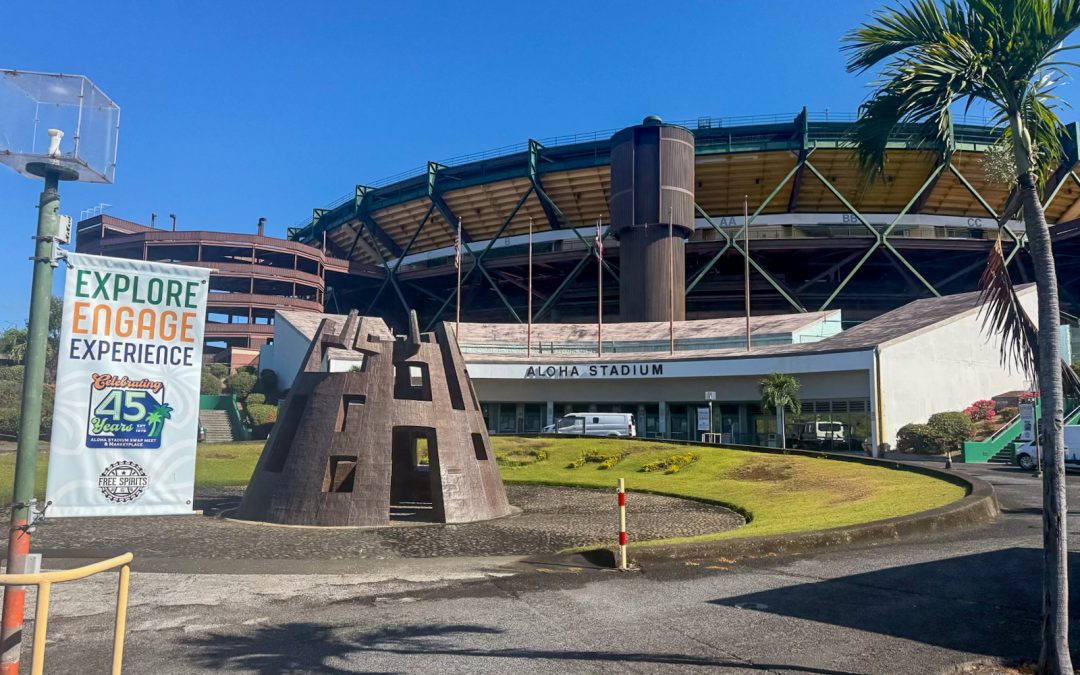
The Satoru Abe sculpture known as “the volcano” will also be preserved and incorporated into a public park. Stadium seats will be auctioned off to fans to honor decades of memories.

New Stadium Design

Design work is expected to begin in October and wrap up in December. The project will use a design-build approach, allowing construction and design to occur simultaneously.

Phase one of the stadium will include 22,500 seats, 10 suites, a club lounge, press box, and lower bowls. Phase two would expand seating to between 44,000 and 46,500, with all foundations prepared for the full build-out.

Populous, the global architecture firm behind projects such as Las Vegas’ Sphere and Colorado State’s Canvas Stadium, is leading design efforts. AECOM Hunt will manage construction.

Carr confirmed that all seats in the new stadium will be individual chairs with cup holders, with limited bleacher seating planned for the east side.

University of Hawaii Partnership

The University of Hawaii will be the stadium’s primary tenant under a license agreement negotiated with UH Athletics Director Matt Elliott. UH will control ticketing, suites, lounges, and parking revenue. The facility will also host high school football, graduations, and potentially international events such as soccer and rugby matches.

Beyond Football

Carr said the redevelopment team has fielded interest from Live Nation for concerts and from professional sports leagues, including U.S. Soccer and rugby organizations. Plans also call for a Hawaii Sports Hall of Fame Museum inside the stadium to keep the venue active year-round.

Location and Transportation

The Halawa site was reaffirmed as the most suitable location due to its central position on Oahu and future connectivity to Honolulu’s Skyline rail. Early years will allow for traditional tailgating, though long-term plans include vertical parking structures and mixed-use development integrated with residential and commercial spaces.

Housing and Mixed-Use Development

The broader district will eventually include 4,000 to 4,500 housing units, two to three hotels, retail and dining spaces, cultural attractions such as a Hawaii Music Hall of Fame Museum, and potentially a new multi-story school. Residential construction is expected to begin around 2029 or 2030.

Financial Model

ASM Global will manage stadium operations under a design-build-operate-maintain contract, ensuring upkeep over 30 years without additional requests to the Legislature. Revenue from real estate components is expected to subsidize stadium maintenance.

Carr described the vision as a “transit-oriented community” blending housing, entertainment, hospitality, and cultural elements, with the project addressing both Hawaii’s housing needs and the state’s demand for modern event facilities.

“This is about creating a place where people can live, work, play, learn, and thrive,” Carr said.

The comments from Carr and Morioka were shared during a recent episode of Spotlight Now on Hawaii News Now.

Stadium authority agree on terms for new stadium: the good news and ‘not so good news’

Stadium authority agree on terms for new stadium: the good news and ‘not so good news’

Stadium authority agree on terms for new stadium: the good news and ‘not so good news’

BY MICHAEL LASQUERO | HSRN
PUBLISHED AUGUST 14, 2025

‘AIEA — After talks of a new aloha stadium in Hawai’i being on the proverbial 10-yard line and at first-and-goal, points are now on the scoreboard.

Now were those points a touchdown or a field goal? That depends on perspective.

Wednesday morning marked a momentous step forward for construction for the New Aloha Stadium Entertainment District (NASED) as the Stadium Authority board voted unanimously in a special session to finalize terms of a new stadium agreement with master developer Aloha Halawa District Partners (AHDP).

Demolition of the existing structure that was condemned is still on track to take place by the end of August with the final permits expected to be approved next week.

But officials say the stadium’s timeline has been pushed back from August 2028 to March 2029 and that the seating capacity in the current plans have been reduced from 25,000 to 22,500.

Former Stadium Authority Board chair Brennon Morioka — and current senior advisor to Gov. Josh Green for the NASED project — has always maintained that there will be transparency in the project’s developmental progress.

When he addressed the media after the board’s special session, Morioka said that entails “the good news as well as some of the not so good news.”

Brennon Morioka addresses the media following the stadium authority board special session.

THE GOOD NEWS

The conclusion of Wednesday’s special session resulted in a milestone achievement that was put into motion over two decades ago. It should be celebrated.

Current board chair Eric Fujimoto said the conversation of building a new aloha stadium started in 2002 when Charlie Taguchi was leading the board. Then during Ross Yamasaki’s leadership, the board was able to get deed restrictions and approach the state legislature for funding for a new structure which then was secured during Morioka’s time as chair.

The unanimous vote by the board on Wednesday authorizes interim stadium manager Chris Sadayasu permission to finalize the ground lease agreement and operations agreement with AHDP, stadium leadership and the state’s Department of Accounting and General Services.

The state of Hawai’i has never reached this point in its many attempts to rebuild aloha stadium, even before it was condemned at the end of 2020. There were plans to build a new stadium while the old one was still operational during David Ige’s time as governor while current Gov. Josh Green switched gears on the project during the 2023 legislative session before restarting the project in December 2023.

Demolition of the existing structure will begin in the coming weeks. There will be physical signs of the old stadium being taken down to make way for the new.

The final permits needed for a piece-by-piece demolition is expected to take be approved next week, stadium officials said.

It was a permitting process put into motion by AHDP a few months ago — before any agreement by parties involved had been reached. This was done ahead of time so that demolition could start almost immediately when contracts are actually signed.

“As a local guy that lives in the Pearl City-Aiea area, to see demolition occur is just going to be a huge psychologically for our community,” Fujimoto said.

Stadium Authority Chair Eric Fujimoto addresses the media.

While the state and AHDP still need to agree on two aspects of the full contract — a mater development agreement and a shared infrastructure agreement — the board’s vote to approve of the ground lease agreement ensures that demolition can begin.

The terms of the stadium contract that is being agreed upon do not have any future burden on taxpayers — unlike other state projects.

During Ige’s time as governor of Hawai’i, he signed Act 248 into law, which allocated approximately $400 million towards the NASED project — specifically $350 million in general obligation bond funds for the Capital Improvement Project related to the new stadium.

Those monies will not completely cover the price tag of a new stadium, so the expectation is that AHDP has to fund the difference needed.

“It’s important for the public to understand and make sure that they know the state right now is only committed to $350 million dollars,” Morioka said.

“Not only is the state making a significant investment, but AHDP is making a significant investment in this stadium as well.”

The new stadium will be constructed in a way that can be expanded upon without halting operations. If there is a need and resources to increase capacity, there is the option to.

While the state is currently not committing more than the $350 million towards the current stadium plans, there is a possibility that additional external monies come in that can help support a bigger, better stadium, Morioka said.

If those additional funds from other parties become a reality, Morioka said expanding on the stadium’s seating capacity can take place. Morioka, who is the Dean of College for Engineering at the University of Hawai’i, said the current stadium plans will use an additive type of construction.

“Everything that might come in the future, even if it’s near term or long term, it’s additive that they can just build onto the current stadium that they’re going to be building so that there’s not as much disruption towards the use of the stadium should we start adding on, which we do have a high level of confidence that we’ll be able to do so in the future,” Morioka said.

THE NOT SO GOOD NEWS

The 22,500 seating capacity in the current plans that was agreed upon by the stadium authority board is below the minimum amount of seats that was required.

The current attempt at building a new stadium began in December 2023 when the state published a Request for Proposals (RFP) that outlined a three-stage procurement process in hopes of finding a private developer entity to serve as the master developer for NASED.

One of the key features of the RFP states that “the master developer will be responsible for designing, building, operating, and maintaining the new Aloha Stadium with a minimum of 25,000 seats.”

There were two priority-listed offers that were selected in March 2024 as finalists to bid for the NASED contract but one of the two developmental teams withdrew its name a few months later and AHDP was the only option for the state to continue negotiations with.

The timeline of construction completion of the new stadium was pushed back from August 2028 to March 2029, partially because of factors that are outside of the state’s control.

The projected completion of August 2028 for the new stadium was a timeline set in place in December 2023. Morioka hinted at the previous stadium authority board meeting that timeline could become  “end of 2028” before announcing of its current projected finish on Wednesday.

Morioka told the media after the special session that August 2028 was an “aggressive date to target” while March 2029 is a “very realistic date, very achievable date.”

He said that conversations with AHDP and their contractors — such as Hawaiian Dredging — and the current environment of tariffs and material supply chains led to the new timeline.

China is the world’s biggest producer of steel, but the United States increased the tariffs on steel from 25% to 50% in June 2025.

The final price tag of the new stadium is not set in stone. There is a limit to how much AHDP wants to spend, which could affect quality of final product.

When Morioka said that the state is only committed to $350 million dollars towards the stadium, he also said: “we’re probably looking at AHDP putting in upwards of $475 million dollars total for a new stadium.”

However, a NASED official later clarified to HSRN that the $475 million amount only relates to the total cost of the stadium, not how much AHDP is giving to the project.

AHDP is also in charge of the demolition process and costs, with plans to preserve the existing cement foundations of the end zones of the former stadium to help save nearly $90 million.